
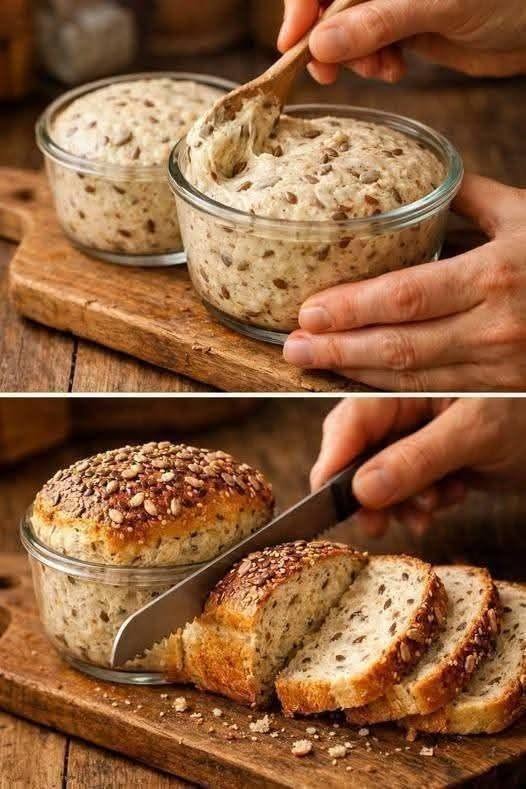
3-Ingredient No-Yeast Seeded Bread (Gluten-Free Option)
Description
This 3-Ingredient No-Yeast Seeded Bread is a quick, wholesome, and beginner-friendly bread recipe that requires no yeast, kneading, or long rising time. It’s made with self-rising flour (or a gluten-free equivalent), plain yogurt, and mixed seeds to create a soft, hearty loaf with a lightly crisp crust. Perfect for breakfast, sandwiches, soups, or healthy snacks, this bread is packed with texture and nutrition from the seeds.
Preparation Time
- Prep Time: 10 minutes
- Bake Time: 35–40 minutes
- Total Time: 45–50 minutes
Ingredients
- 2 cups self-rising flour (or gluten-free self-rising flour blend)
- 1 cup plain Greek yogurt
- ½ cup mixed seeds (sunflower, pumpkin, sesame, flax, chia)
Optional
- ½ teaspoon salt
- 1 tablespoon honey
- 1 teaspoon dried herbs
- Extra seeds for topping
Equipment
- Mixing bowl
- Wooden spoon
- Loaf pan (8×4 inches)
- Parchment paper
- Measuring cups
- Cooling rack
Instructions
Step 1
Preheat oven to 375°F (190°C).
Step 2
Line a loaf pan with parchment paper or lightly grease it.
Step 3
In a large bowl, combine the self-rising flour and mixed seeds.
Step 4
Add the Greek yogurt and stir until a rough dough forms.
Step 5
Transfer the dough onto a lightly floured surface and gently fold 8–10 times until it comes together. Avoid over-kneading.
Step 6
Shape into a loaf and place in the prepared pan.
Step 7
Sprinkle extra seeds over the top and gently press them into the dough.
Step 8
Bake for 35–40 minutes, or until golden brown and the loaf sounds hollow when tapped.
Step 9
Cool in the pan for 10 minutes before transferring to a wire rack.
Step 10
Allow the bread to cool completely before slicing.
Chef’s Notes
- Greek yogurt gives the bread moisture and protein.
- Do not overmix, or the bread may become dense.
- Gluten-free flour blends can vary; if the dough feels dry, add 1–2 tablespoons yogurt.
- A darker loaf usually has a richer flavor and firmer crust.
Tips for Success
- Measure flour correctly by spooning it into the measuring cup.
- Use fresh self-rising flour for the best rise.
- Toast slices before serving for extra crunch.
- Let the bread cool fully before slicing.
- Store leftovers wrapped tightly to maintain moisture.
Variations
Herb Bread
Mix in rosemary, thyme, or oregano.
Sweet Breakfast Bread
Add cinnamon and a tablespoon of honey.
Cheese Bread
Fold in ½ cup shredded cheddar or Parmesan.
Nutty Bread
Add chopped walnuts or pecans.
Everything Bread
Use Everything Bagel seasoning instead of mixed seeds.
Serving Suggestions
- Toast with butter
- Avocado toast
- Peanut butter and banana
- Soup companion
- Sandwich bread
- Cheese board
- Breakfast with eggs
- Served alongside salads
Servings
Makes: 8 slices
Serving Size: 1 slice
Estimated Nutritional Information (Per Serving)
| Nutrient | Amount |
|---|---|
| Calories | 170 |
| Protein | 8 g |
| Carbohydrates | 21 g |
| Fat | 6 g |
| Fiber | 3 g |
| Sugar | 2 g |
| Sodium | 280 mg |
| Calcium | 90 mg |
| Iron | 1.5 mg |
Values are approximate and will vary depending on the flour, yogurt, and seed mix used.
Health Benefits
- Good source of protein from Greek yogurt to help support muscle maintenance.
- Rich in healthy fats from seeds, including heart-friendly unsaturated fats.
- Provides dietary fiber to promote digestive health and satiety.
- Contains essential minerals such as magnesium, zinc, iron, and calcium.
- No yeast required, making it a convenient option when time is limited.
- Gluten-free adaptable by using a certified gluten-free self-rising flour blend.
- Versatile for both savory and lightly sweet meals.
Storage
Room Temperature: Up to 2 days in an airtight container.
Refrigerator: Up to 5 days.
Freezer: Freeze slices for up to 2 months. Separate slices with parchment paper for easy thawing.
Frequently Asked Questions (Q&A)
1. Can I make this bread gluten-free?
Yes. Use a gluten-free self-rising flour blend or make your own with gluten-free flour, baking powder, and salt.
2. Why doesn’t this recipe use yeast?
Self-rising flour provides the leavening through baking powder, eliminating the need for yeast or proofing.
3. Can I use regular yogurt?
Yes. Greek yogurt creates a thicker dough, but plain yogurt also works. If using thinner yogurt, add a little extra flour if needed.
4. What seeds work best?
Sunflower, pumpkin, sesame, flax, and chia seeds all work well. You can use any combination.
5. Can I add oats?
Yes. Replace up to ¼ cup of the flour with rolled oats for additional texture.
6. Why is my bread dense?
Overmixing, using expired self-rising flour, or adding too much flour can result in a dense loaf.
7. Can I bake it without a loaf pan?
Yes. Shape the dough into a round loaf and bake it on a parchment-lined baking tray, checking for doneness after about 30–35 minutes.
8. How do I know when it’s fully baked?
The loaf should be golden brown, feel firm, and sound hollow when tapped on the bottom. An internal temperature of about 200–205°F (93–96°C) indicates it is fully baked.
9. Can I make it dairy-free?
Yes. Substitute the Greek yogurt with a thick, unsweetened dairy-free yogurt such as coconut or soy yogurt.
10. Can I toast this bread?
Absolutely. Toasting enhances the flavor, adds crispness, and makes it excellent for sandwiches or breakfast toppings.