
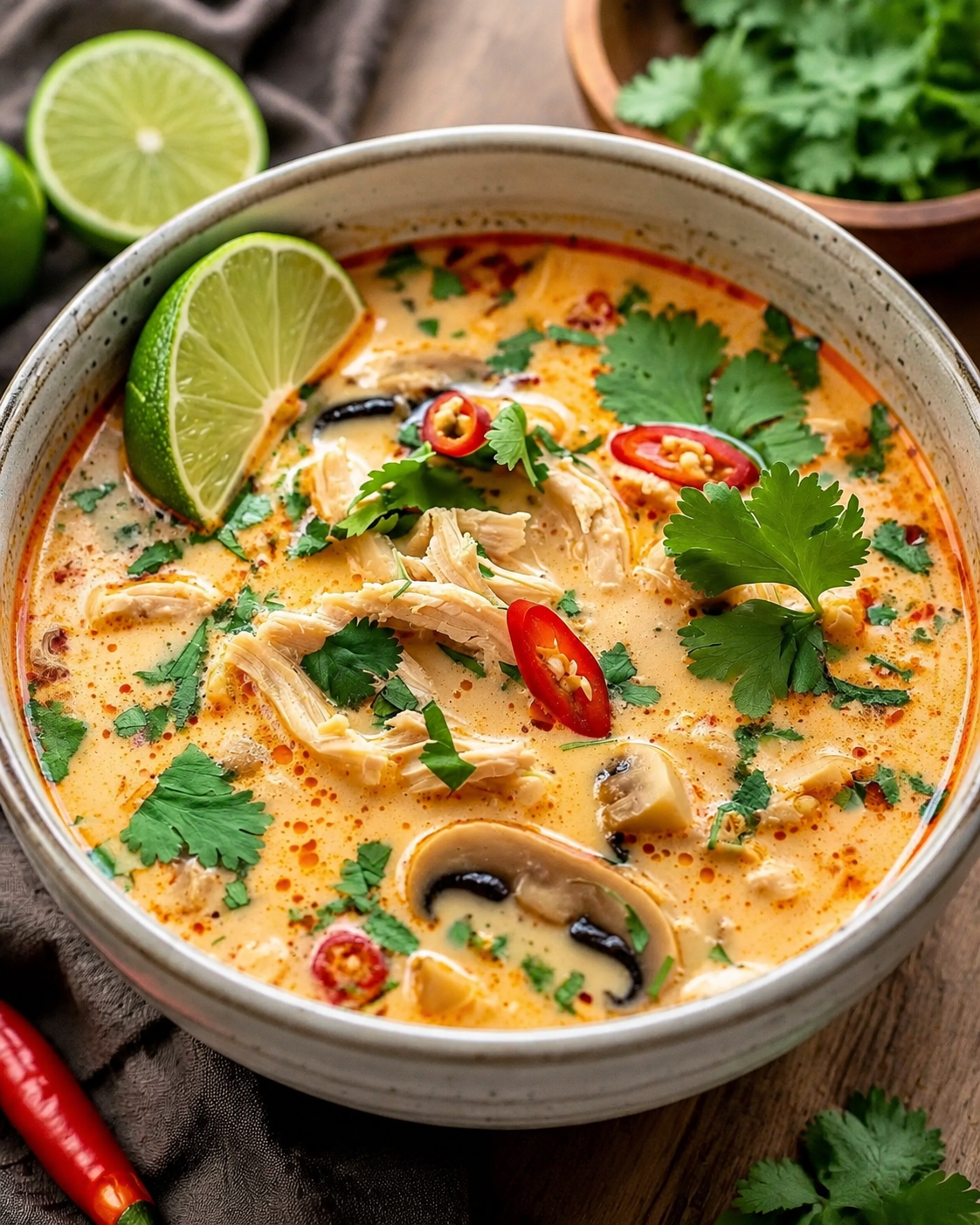
Thai Coconut Chicken Soup
Description
Thai Coconut Chicken Soup is a creamy, fragrant, sweet-savory soup inspired by the flavors of Thai Tom Kha Gai. Tender chicken breast and mushrooms simmer gently in a rich combination of coconut milk and chicken broth flavored with lemongrass, galangal or ginger, kaffir lime leaves, fresh lime juice, and a touch of chili.
What makes this soup so satisfying is the balance of flavors. Coconut milk provides richness, lime brings fresh acidity, fish sauce adds savory depth, and aromatic herbs give every spoonful a fresh, vibrant finish. Mushrooms absorb the flavorful broth while thinly sliced chicken cooks quickly and stays tender.
It looks impressive enough for entertaining but can easily become a weeknight dinner. Serve it as-is for a lighter meal or add jasmine rice or rice noodles for something more substantial.
Ingredients
For the Soup
- 1 lb boneless, skinless chicken breast, thinly sliced
- 2 cups full-fat coconut milk, about 1 can
- 2 cups low-sodium chicken broth
- 2 stalks lemongrass, smashed and cut into 2-inch pieces
- 4 slices fresh galangal or ginger
- 4 kaffir lime leaves, torn, or 1 teaspoon finely grated lime zest
- 8 oz button, cremini, shiitake, or oyster mushrooms, sliced
- 2 cloves garlic, minced
- 1 small shallot, thinly sliced
- 1–2 red Thai chilies, thinly sliced
- 1 tablespoon neutral oil or coconut oil
- 2 tablespoons fish sauce
- 1 teaspoon brown sugar or coconut sugar
- 2–3 tablespoons freshly squeezed lime juice
- ½ teaspoon red pepper flakes, optional
- Salt, as needed
For Garnishing
- ½ cup fresh cilantro leaves
- 2 green onions, thinly sliced
- Fresh red chili slices
- Lime wedges
- Extra cilantro
- Optional chili oil
Optional for Serving
- Cooked jasmine rice
- Cooked rice noodles
Instructions
1. Prepare the Chicken
Pat the chicken breast dry and place it on a clean cutting board.
Slice it against the grain into thin, bite-sized strips.
Keeping the pieces relatively thin and even allows them to cook quickly without becoming dry.
Set aside while preparing the aromatics.
2. Prepare the Lemongrass
Remove any tough outer layers from the lemongrass.
Trim the dry ends and use the flat side of a knife to gently smash the stalks.
Cut each stalk into approximately 2-inch pieces.
Smashing the lemongrass helps release its aromatic oils into the broth.
The lemongrass pieces aren’t generally eaten; they flavor the broth and can be removed before serving.
3. Prepare the Galangal or Ginger
If you can find fresh galangal, use it for a more traditional flavor.
Slice it into thin rounds.
Fresh ginger makes a convenient substitute and produces a slightly different but still delicious soup.
4. Prepare the Kaffir Lime Leaves
Gently tear the lime leaves with your fingers.
This helps release their fragrance.
If kaffir/makrut lime leaves aren’t available, use approximately 1 teaspoon fresh lime zest instead.
Don’t substitute bottled lime juice at this stage—the zest provides aromatic oils rather than simply acidity.
Make the Soup
5. Sauté the Aromatics
Heat a large soup pot over medium heat.
Add 1 tablespoon oil.
Add the shallot and cook for approximately 2 minutes, until slightly softened.
Add garlic and cook for another 30 seconds.
Don’t allow the garlic to burn.
6. Add the Broth
Pour in the chicken broth.
Add:
- Lemongrass
- Galangal or ginger
- Kaffir lime leaves
- Optional red pepper flakes
Bring the mixture to a gentle simmer.
7. Infuse the Broth
Reduce the heat to medium-low and allow the broth to simmer gently for approximately 8–10 minutes.
This step gives the lemongrass, ginger or galangal, and lime leaves time to release their flavor.
The kitchen should begin smelling wonderfully citrusy and aromatic.
8. Add the Coconut Milk
Pour in the coconut milk.
Stir gently until completely incorporated with the broth.
Keep the heat moderate.
A gentle simmer is better than a vigorous boil because coconut-based soups can separate when boiled aggressively.
9. Add the Mushrooms
Add the sliced mushrooms.
Simmer for approximately 3–4 minutes, until they begin to soften.
Oyster mushrooms are particularly delicious because they have a tender texture and absorb the coconut broth beautifully.
10. Cook the Chicken
Add the thinly sliced chicken.
Separate the pieces with a spoon so they don’t clump together.
Simmer gently until the chicken is fully cooked, approximately 5–7 minutes, depending on thickness.
Chicken should reach an internal temperature of 165°F (74°C).
Avoid prolonged boiling, which can make chicken breast tough.
11. Season the Soup
Stir in:
- Fish sauce
- Brown or coconut sugar
- Sliced red chili
Taste the broth.
At this point, it should taste creamy, aromatic, savory, and lightly sweet.
12. Add Lime Juice
Turn the heat to low or remove the pot from the heat.
Stir in 2 tablespoons fresh lime juice.
Taste and add the final tablespoon if you want more acidity.
Adding lime juice near the end preserves its bright, fresh flavor.
13. Final Taste Test
Thai-inspired soups are all about balance.
If the soup tastes too rich, add more lime.
If it needs more savory depth, add a little fish sauce.
If it’s overly acidic, add a small pinch of sugar.
If you want additional heat, add fresh chili or chili oil.
14. Remove Tough Aromatics
Before serving, remove the larger lemongrass pieces, galangal slices, and lime leaves if desired.
They’re used primarily to flavor the broth and can be unpleasant to bite into.
15. Garnish and Serve
Ladle the hot soup into bowls.
Top generously with:
- Fresh cilantro
- Green onions
- Thinly sliced red chili
- Fresh lime wedges
For a restaurant-style finish, add a few drops of chili oil across the creamy surface.
Serve immediately.
Notes
Coconut Milk
Use full-fat canned coconut milk for the richest and creamiest broth.
Light coconut milk can be substituted, but the finished soup will have a thinner consistency.
Shake or stir canned coconut milk before measuring because the coconut cream can separate from the liquid during storage.
Galangal vs. Ginger
Traditional Tom Kha-style soup uses galangal.
Galangal has a sharper, citrusy, slightly peppery flavor that isn’t identical to ginger.
However, fresh ginger is much easier to find in many grocery stores and still produces an excellent coconut chicken soup.
Kaffir/Makrut Lime Leaves
These leaves add an unmistakable citrus fragrance.
If unavailable, fresh lime zest is the easiest substitute.
Tips for the Best Thai Coconut Chicken Soup
Don’t aggressively boil the coconut milk. Keep the soup at a gentle simmer for a smooth, creamy consistency.
Slice the chicken thinly. Thin pieces cook quickly and stay tender.
Use fresh lime juice. Bottled lime juice doesn’t provide the same bright flavor.
Don’t skip the aromatics. Lemongrass, ginger or galangal, and lime leaves are responsible for much of the soup’s characteristic flavor.
Add lime at the end. Long cooking dulls its freshness.
Adjust the heat to your preference. Start with one chili and add more after tasting.
Taste before adding salt. Fish sauce and chicken broth both contribute sodium.
Use full-fat coconut milk when possible. It gives the broth its luxurious mouthfeel.
Variations
Thai Coconut Shrimp Soup
Replace chicken with peeled and deveined shrimp.
Add shrimp near the end because they only require a few minutes of cooking.
Chicken & Vegetable Coconut Soup
Add vegetables such as:
- Red bell pepper
- Baby spinach
- Bok choy
- Snow peas
- Carrots
- Zucchini
Add firm vegetables earlier and delicate greens near the end.
Coconut Chicken Noodle Soup
Add cooked rice noodles to each serving bowl and ladle the hot soup over them.
Coconut Chicken Rice Soup
Add approximately ½ cup cooked jasmine rice to each bowl before adding the soup.
Spicier Version
Increase the Thai chilies or finish each bowl with chili crisp or chili oil.
Serving Suggestions
Thai Coconut Chicken Soup can be served alone, but it pairs especially well with:
- Steamed jasmine rice
- Coconut rice
- Rice noodles
- Cucumber salad
- Fresh vegetable spring rolls
- Steamed vegetables
For a satisfying dinner, place jasmine rice in the bottom of a bowl and spoon the soup around it.
A fresh lime wedge on the side lets everyone adjust the acidity themselves.
Servings & Cooking Time
Prep Time: 15 minutes
Cook Time: 25 minutes
Total Time: Approximately 40 minutes
Servings: 4 generous bowls
Nutritional Information
Approximate Per Serving
- Calories: 390
- Protein: 30 g
- Carbohydrates: 12 g
- Fat: 26 g
- Saturated Fat: 18 g
- Fiber: 2 g
- Sugar: 5 g
- Sodium: 720 mg
Nutrition is an estimate and varies depending on the coconut milk, broth, fish sauce, chicken portion, and optional additions.
Adding rice or noodles will increase the calories and carbohydrates.
Benefits
Good Source of Protein
Chicken breast provides high-quality protein, helping make the soup satisfying and substantial.
Mushrooms Add Nutrients
Mushrooms provide B vitamins, minerals, and other naturally occurring compounds while adding volume and a savory flavor without requiring a heavy ingredient.
Fresh Herbs Add Flavor
Cilantro, lemongrass, ginger or galangal, and lime provide plenty of flavor, allowing the soup to taste vibrant without relying solely on salt.
Flexible Vegetable Base
It’s easy to add additional vegetables such as spinach, peppers, bok choy, or zucchini, making the soup adaptable to whatever you have available.
Comforting and Satisfying
The combination of protein, creamy coconut milk, mushrooms, and aromatic broth makes this a substantial soup that can work as a complete light meal.
Coconut milk is rich in saturated fat, so portion size can be adjusted according to individual dietary preferences.
Storage
Allow leftover soup to cool and transfer it to an airtight container.
Refrigerate promptly and use within approximately 3–4 days.
Keep rice or noodles in separate containers if possible. Otherwise, they’ll continue absorbing the broth and may become very soft.
Reheating
Reheat the soup gently in a saucepan over medium-low heat.
Avoid bringing it to a hard boil.
Stir occasionally until thoroughly hot.
Add a fresh squeeze of lime and some new cilantro after reheating to revive the bright flavors.
Q&A
Can I use chicken thighs?
Yes. Boneless, skinless chicken thighs are excellent in this recipe and have a slightly richer flavor.
Can I use rotisserie chicken?
Yes. Add shredded cooked chicken during the final few minutes, just long enough to heat it thoroughly.
What can I use instead of galangal?
Fresh ginger is the easiest substitute. The flavor won’t be exactly the same, but the soup will still be delicious.
What if I can’t find kaffir lime leaves?
Use approximately 1 teaspoon fresh lime zest. Add additional fresh lime juice at the end according to taste.
Can I make it vegetarian?
Yes. Replace chicken broth with vegetable broth and chicken with tofu. Replace fish sauce with an appropriate vegetarian savory seasoning or soy sauce.
Can I add noodles?
Absolutely. Rice noodles work particularly well. Cook them separately and place them into individual bowls before adding the soup.
Why did my coconut milk separate?
It may have been boiled too aggressively. Coconut soup should simmer gently rather than cook at a rolling boil.
A little natural separation isn’t harmful and can often be improved simply by stirring.
Is this soup spicy?
It can be mild or spicy. Use one chili for gentle heat, additional chilies for a stronger kick, or leave them out completely.
Can I make it ahead?
Yes. The soup can be prepared a day ahead and refrigerated. For the freshest flavor, add additional lime juice, cilantro, and green onions after reheating.
Can I freeze Thai Coconut Chicken Soup?
You can, although coconut milk may separate slightly after freezing and thawing. Stirring gently while reheating usually helps restore the consistency. Mushrooms may also become softer.
What makes Thai Coconut Chicken Soup taste so good?
The key is balance. Rich coconut milk needs the acidity of fresh lime, savory fish sauce, aromatic lemongrass and galangal or ginger, and just enough chili to provide warmth.
When those elements are balanced correctly, every spoonful has creamy coconut broth, tender chicken, earthy mushrooms, citrusy aromatics, fresh herbs, and a gentle spicy kick—a cozy yet vibrant soup that’s surprisingly easy to make at home.